a new direction for apple #occupytimcooksemailbox

I finally got over to The Public Theater and caught Mike Daisey’s new monologue, The Agony and Ecstasy of Steve Jobs. The monologue alternates between the life of Steve Jobs and Mike’s own experience visiting the Foxconn factories in Shenzhen, China. He reveals how he pretended to be an American businessman to gain access and observe the atrocities, including child labor, 12-15 hour work days, and nets surrounding the buildings to catch workers attempting suicide. It’s a harrowing tale, and you should check it out before it closes on December 4th. If you’re a user of technology, it will change the way you think about, well…almost everything.

A few days after I saw Mike’s show, I discovered Brad Pitt making this statement about the Occupy Wall Street movement:

“If we were inventing the automobile today, would we invent it on a system that relies on a finite fuel source that pollutes the environment and we have to fight wars for to protect…? It makes no sense for us today. We would develop it like our laptops and our iPads. So, to start questioning…and I think what you’re seeing in America is questioning a system that has not served us very well…”
– Brad Pitt

Clearly, Mr. Pitt does not know how companies make our laptops and iPads. Nor do the majority of Americans. As a country, we take and take, but we rarely ask “where is this coming from?” Mike’s monologue not only challenges us to ask this important question, but it further implores us to examine this meme he’s placed in our minds and do something about it.

As part of Mike’s show, I received a sheet of paper suggesting ways I can make a difference. I’ve done these. I’ve written Apple CEO Tim Cook and asked him to consider shifting how Apple creates its products. I’m waiting until my current mobile device is literally on the precipice of death and my contract with my wireless phone company lapses before buying a new device. This way, I pay as little to these corporations as possible and I minimize the hype surrounding the devices. I’ve educated myself, and I’m telling you. Look beyond the face of your mobile device or computer and try to see the thousands of faces of abused humans who created them.

Mr. Pitt is right about one thing. The Occupy Movement that started down at Occupy Wall Street questions and confronts injustices and imbalances in our system. In light of yesterday’s eviction from Zuccatti Park, I’d like to propose a new place to occupy:
Tim Cook’s email box
.

This technology is here to stay, but the horrors of Foxconn and other technology producing companies don’t have to. I implore you to look at what Mike shared with me below and find out for yourself.

Mike Daisey, Photograph: Kevin Berne

WHAT HAPPENS NEXT?
That lies in your hands. If you choose not to ignore what you’ve learned tonight, here are some concrete steps you can take.

You Can Speak To Apple
Apple’s new CEO is Tim Cook, and his email address is tcook@apple.com. He receives email sent here, and he and others at Apple sometimes respond. Don’t abuse this email address. Please be firm, polite, resolute, and clearheaded. Cook made his name at Apple by establishing Apple’s supply chain in Southern China as it exists today – everything you’ve heard about tonight springs from initiatives he spearheaded in his years as Apple’s COO.  You can expect him to tell you about Apple’s Supplier Responsibility Report, a document written without any independent verification or oversight whose accuracy has been contested by a number of human rights organizations. Ask Cook to take the lead – Apple could be the first electronics manufacturer to allow independent, outside verification of working conditions in factories. They could reform, and in doing so begin a revolution in working conditions for millions of people.

You Can Think Different About Upgrading
When Apple releases their next amazing device, you can ask yourself if you really need to upgrade immediately. Instead of pumping money and support into the electronics industries, you can step back and try to only upgrade when it is truly needed, and drain some of the mania out of our endless upgrade cycle. Choosing not to participate is not only ethically defensible, but economically sensible—we pay huge premiums to buy brand-new technology at the moment it is released, and for many users it would save money if they weighed the human cost of each piece of technology, and became more stringent in their purchasing. You can push back.

You Can Connect and Educate Yourself
Like the beginnings of many movements, awareness counts. Making people aware of labor conditions in China, and the systems we’ve created to feed it, is an ongoing process. Organizations like China Labor Watch (chinalaborwatch.org) and SACOM (sacom.hk) work to track and hold accountable our largest corporations which routinely abuse, poison, and exploit China’s people to make electronics. Apple is hardly alone—every major electronics manufacturer uses the same inhumane labor practices in the creation of their products. We are advocating for pressuring Apple specifically because they are industry leaders, but some may wish to call Nokia, Dell, Samsung, LG, Motorola and others.

You Can Tell Others
This is a monologue—a single voice telling a story of a single experience. But if I have opened a door for you, consider opening a door for others. We do not like to think about our relationship with China and the true cost of our labor, but that silence can only exist if we are complicit with it. Talking about it, thinking about it when making purchasing decisions, and understanding it is not just symbolic. In world of silence, speaking itself is action. It can be the first seeds of actual change. Do not be afraid to plant them.

Spread the virus,
md

it’s so absurd

This morning, I woke up confused. And a little disappointed. It’s because of this.

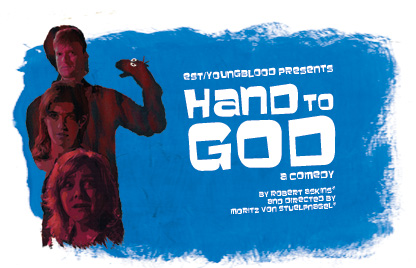
I’m confused because it doesn’t seem Diane Snyder saw the same play I saw. Or, perhaps she was reviewing a play she wished she was seeing. Whatever the case, I’m troubled because I generally praise Time Out New York for reviewing a play for what it is, rather than what they wish it might be.

Specifically, Ms. Snyder wrote:

 “This wickedly twisted premise unfortunately strays far from the path of logic, putting shock ahead of sense.”

So many great plays have done this. Absurdist gems like Rhinoceros, Pterodactyls, Sister Mary Ignatius Explains It All For You, and The House of Blue Leaves  paved the way for the smart hilarity that is Hand to God.

But maybe, Ms. Snyder thought she was seeing a play by Greenberg or Simon.

I don’t know.

The problem is: no one reading the review in Time Out New York will know how sorely the review misrepresents Hand to God. Readers will think it is a traditional comedy about a teenage boy trying to get over his father’s death. Sure, this is the plot, but more importantly, it’s a brilliant, absurdist morality play revealing how people manifest mythology, like the devil and sin. Any time puppets appear on stage they are a metaphor for something larger. If Ms. Snyder focused on the play’s raucous metaphors rather than its literal storytelling, perhaps she would have seen what I saw.

Here’s my perspective:

Steve Boyer and Scott Sowers. Photo: Gerry Goodstein

Steven Boyer knocks it out of the park with a career making performance. His nuanced performances as both Jason, the teenage boy who recently lost his father, and Tyrone, a possibly devil-possessed puppet, should win awards and earn him work. It’s a tour de force in the truest sense of the phrase. Through him, the funniest fight with one’s own hand since Evil Dead and the hottest puppet sex since Avenue Q currently grace The Ensemble Studio Theatre‘s main stage. The best thing Ms. Snyder wrote was that his performance is “a big hallelujah.” Amen, to that.

Geneva Carr and Scott Sowers. Photo: Gerry Goodstein

Geneva Carr is magnificent and slightly frightening as Jason’s tortured, widowed mother, knowing she doesn’t need the consoling, security of a man her own age. She wants the release of a teenage boy’s cock. She wants to feel the pain. If ever someone literally took the advice of Peaches, it is this woman.

Pastor Greg, earnestly played by Scott Sowers, grounds the play. He is that audience member asking “WTF?!” We accept everything onstage because this guy doesn’t get it either. In the end, it’s his blind faith and moralizing that is the butt of the play’s joke.

Bobby Moreno was born to play the part of Timothy. He has one objective: to get laid. Sometimes, characters only exist to make us laugh, push the story forward and offer some of the best physical comedy you can find in the theatre. This is Timothy’s role, but Bobby brings pathos to this single minded boy. And he’s funny as hell.

Megan Hill embodies Hand to God‘s ingénue, Jessica, with awkwardness, sweetness and a simmering sexuality. She’s the smartest of the bunch and the voice of reason. She makes us understand love, connection and sincerity and isn’t found in a book or set of rules, dead fathers or socks shoved onto one’s hand. These joys are discovered in other living human beings willing to turn the rock over and see a beauty no one else understands.

Megan Hill and Steve Boyer. Photo: Gerry Goodstein

Then, there’s Tyrone. Oh, Tyrone. Like so many ids who’ve come before him, Tyrone is the embodiment of young Jason’s desires. He’s everything Jason wishes he could be. Jason doesn’t want to admit it, and he doesn’t like it. But the venomous words Tyrone spits at other characters and the audience are deep truths. And, as we all know, the devil speaks the cold, hard truth. He has since the beginning. And he does again here in the form of the potty-mouthed Tyrone.

Orchestrated with deft precision by Moritz von Stuelpnagel, the hilarity of his mad-capped crew rarely lets up, but when it does, the simple offerings of human connection are never overly sentimentalized. Some of the best physical comedy this season is in this production, and Moritz deserves credit for bringing this brilliant play to life.

Like his predecessors before, Robert Askins’ wrote a new absurdist gem in Hand to God. He joins a young crop of smart and bizarre playwrights, like Leah Nanako Winkler and Josh Conkel, who create uniquely theatrical experiences bent on forcing us to examine our humanity and the silliness of it all. These voices must be encouraged and appraised for what they are, not what reviewers wish they were. They create outlandish scenarios that serve as metaphors for the overly sentimental, stuffed-up, class-driven realism passing for plays these days.

It isn’t experimental theatre. It isn’t kitchen sink. It is absurdity its best, and it’s a departure for The Ensemble Theatre. Artistic director William Carden should be praised for having the guts to produce it.

Okay. I’m done.

Please, don’t consider this a review. An open letter to Diane Snyder of Time Out New York? Maybe. An endorsement? Definitely.

In the end, I’m just a playwright, hoping to help another schmoe who’s in the same boat. Rob’s a brother in theatre, and he deserves for people to see his work for what it is.

Go see Hand to God before it closes on November 20th. It’s wicked good.

the secret city – join me

This past Sunday, I returned home.

For the past three years, I’ve attended The Secret City, a monthly gathering of artists and art worshipers. Chris Wells, the dynamic director of this innovative, not-for-profit arts organization, started the community driven pseudo-church five years ago, receiving accolades from The New York Times and the Village Voice Obie awards. Last season, we outgrew our modest space on West 14th Street in Manhattan to our current home at Dixon Place on the Lower East Side. Every September, The Secret City celebrates the town in which we reside with The Manhattan Wonderwalk, a 14 hour expedition from the northern tip of the island ending at midnight on the Brooklyn Bridge. Along the way, participants discover the city through fresh eyes and enjoy performances by various artists at site specific locations.

To say The Secret City has impacted my life is an understatement. For anyone who’s ever felt spirituality in art, our community aims to nurture this core principle: within all of us, there is a nugget of creativity, a light that sustains us from this moment to the next. The Secret City fosters that light.

Once a month, Chris devises a service modeled off a traditional western Christian church service. It’s not religious. It’s spiritual. There’s song, there’s call and response, we pass the plate to support the organization, and, of course, there’s lots of art.

photograph by Beth Rudock

Typically, The Secret City Singers, the church’s choir and Chris’ ad hoc backup singers, kick off the service with the org’s anthem “This is the Secret City”. Its communal refrain, “WE’RE CONNECTED,” is the interdependence themed mission that begs the community to dig deeper and find “it” (Can you…feel it? Can you…touch it? Can you…make it live?) within ourselves.

The service is a trip because initially it feels like it might be tongue in cheek, but upon further familiarity, earnest message of each service permeates the congregation. Each service revolves around a theme. October’s service revolved around “Persona.”

We listened to Nina Simone’s “Who Am I?”, which gave a grave but emotionally reflective tone to the moment, only to be split open with the monthly food offering: sliced apples. We talked about the personality of apples. What makes them unique? How each apple is propagated asexually by grafting. We also did a cultural mapping exercise in which Chris asked questions starting with the phrase, “You identify yourself as…” Examples: You identify yourself as homosexual. You identify yourself as American. You identify yourself as an artist. We stood up for each statement with which we identified and sat down when we did not.

photograph by Leah Coloff

The visual art for October was, perhaps, most moving for me. Sarah Kate Beaumont, an art teacher, makes all of her own garments by hand. The only articles she doesn’t sew herself are shoes. Otherwise, every stitch of clothing is made with her fingers. It was humbling and fascinating to hear Sarah Kate discuss her work, for it was clear: every item is personal to her. She doesn’t just grab something off the rack at Macy’s. She has a deep relationship with her wardrobe.

As with every service, Chris concluded with a sermon. This month’s sermon was a funny and poignant anecdote about Chris’ ten year high school reunion. He compared his high school self to his 28-year-old self, which were drastically different portraits. Then he contrasted those personas to his current incarnation. Chris’ motivation to share stories from his life to buoy others is a special gift.

The theme for the next service is Community. It’s an important topic for many reasons, not the least of which is The Secret City’s annual food drive for the Food Bank of New York. Chris challenged everyone to bring at least one canned goods item to offer the charity.

Chris also put out a second challenge to the congregation: Bring one friend to the next service. He encouraged us to invite new participants to join this community that seeks spiritual nourishment through personal reflection and celebration of art.

So, I’m going to do one better. Or, hopefully, ten better. Part of the reason I’m writing this post is to invite you to join me. My goal is to bring ten new people to the next service. Most likely, if you’re reading this, you’re a friend or a fellow artist (or both). Perhaps, you randomly follow me on one of many social networks. There’s also the chance you dropped by because a search directed you here. Whatever the reason, I highly encourage you to join me at the next service. All the details are below, and it’s coming up quickly.

Join me on November 20th. It’s a fun, moving and grounding affair.

We’re connected.

THE SECRET CITY
COMMUNITY

11:30 am
DIXON PLACE
161A Chrystie St.
http://www.thesecretcity.org

tax parable disciples stoke fire: #ows edition

This morning, I woke to read a post on Facebook. I debated responding, for I typically don’t like getting into disagreements about politics or religion on Facebook. These people are my friends, family and colleagues, and I don’t wish to alienate them.

However, the longer I digested it, the more upset my stomach grew. It’s clear the wealthy still do not understand the plight of the poor. Below, I’ve posted the “Bar Stool Economics” analogy I read on Facebook, and following, is my response.

The fights down at Occupy Wall Street and other Occupations around the world are not about “getting our fair share” or “beating up on the wealthy.” They aren’t only about taxes. They’re about holding big banks and businesses responsible for decades of abuse of honest, hard-working people.

Let’s not just assign numbers to people. Let’s look at both the haves and the have nots as real human beings. Then, maybe the change we desperately need will emerge.

BAR STOOL ECONOMICS

Suppose that every day, ten men go out for beer and the bill for all ten comes to $100 and if they paid their bill the way we pay our taxes, it would go something
like this:

The first four men (the poorest) would pay nothing.
The fifth would pay $1.
The sixth would pay $3.
The seventh would pay $7.
The eighth would pay $12.
The ninth would pay $18.
The tenth man (the richest) would pay $59.)

So, that’s what they decided to do.

The ten men drank in the bar every day and seemed quite happy with the arrangement, until one day, the owner threw them a curve. “Since you are all such good customers,” he said, “I’m going to reduce the cost of your daily beer by $20.” So drinks for the ten now cost just $80.

The group still wanted to pay their bill the way we pay our taxes so the first four men were unaffected. They would still drink for free…but what about the other six men – the paying customers? How could they divide the $20 windfall so that everyone would get his ‘fair share?’. They realized that $20 divided by six is $3.33. But if they subtracted that from everybody’s share, then the fifth man and the sixth man would each end up being paid to drink his beer.

So, the bar owner suggested that it would be fair to reduce each man’s bill by roughly the same amount, and he proceeded to work out the amounts each should pay. And so:

The fifth man, like the first four, now paid nothing (100% savings).
The sixth now paid $2 instead of $3 (33%savings).
The seventh now paid $5 instead of $7 (28%savings).
The eighth now paid $9 instead of $12 (25% savings).
The ninth now paid $14 instead of $18 (22% savings).
The tenth now paid $49 instead of $59 (16% savings).

Each of the six was better off than before…and the first four continued to drink for free. But once outside the restaurant, the men began to compare their savings.

“I only got a dollar out of the $20,”declared the sixth man. He pointed to the tenth man,” but he got $10!”

“Yeah, that’s right,” exclaimed the fifth man who was now paying nothing, along with the first four. “I only saved a dollar, too. It’s unfair that he got ten times more than I!”

“That’s true!!” shouted the seventh man. “Why should he get $10 back when I got
only two? The wealthy get all the breaks!”

“Wait a minute,” yelled the first five men in unison. “We didn’t get anything at all. The system exploits the poor!”

The nine men surrounded the tenth and beat him up.

The next night the tenth man didn’t show up for drinks, so the nine sat down and had beers without him. But when it came time to pay the bill, they discovered something important. They didn’t have enough money between all of them for even half of the bill!

And that, ladies and gentlemen, journalists and college professors, is how our tax system works. The people who pay the highest taxes get the most benefit from a tax reduction. Tax them too much, attack them for being wealthy, and they just may not show up anymore. In fact, they might start drinking overseas where the atmospheres somewhat friendlier.

David R. Kamerschen, Ph.D.
Professor of Economics
University of Georgia

For those who understand, no explanation is needed…
For those who do not understand, no explanation is possible.

THIS WAS MY RESPONSE:

If only everyone would go out drinking together, we could all figure it out.

My guess, though, is the tenth man would never be caught dead at the same bar as the first man, since the tenth man put the first man there by gambling away the first man’s money in hedge funds and bad mortgages.

The second man is a woman, for it should be clear: not all poor or rich people are men. This woman lost her job in 2008 because she worked for the tenth man’s company and they had to downsize. It’s been four years since she’s held a salaried job, and she’s got two sons going to college. She doesn’t know how she’s going to pay outstanding medical bills after her husband died of kidney failure in 2009.

The third man is pushing seventy, unable to retire because his retirement money was tied up in the stock market, so he works at Wal-Mart to make ends meet.

The fourth man is just getting back on his feet after a couple years of unemployment. He temps in a corporate office but loathes his job and the people with whom he works because he watches them scheming to make more money off the pain and suffering of others.

Perhaps, the reason they’re all ganging up on the tenth man isn’t because he “gets all the breaks,” but rather it’s because the tenth man put them there in the first place and wants them to stay there while he continues to profit from poor people’s misfortune.

But maybe I’m over-complicating it.

I, as the esteemed doctor Kamerschen* says, will probably never understand.

* Upon further research, I discovered (after I posted this on Facebook) David R. Kamerschen, Ph.D. didn’t even compose this parable. It’s been clogging email boxes for almost ten years in different forms with spammers attributing it to various economics experts, including Thomas Davies, a Professor of Accounting at the University of South Dakota. While Professor Davies did share this with his graduate students, he did not write the analogy, and he maintains he shared it only to get students to “think outside the box” regarding tax laws.

As with many viral memes, this is inaccurate, overblown and downright destructive. If you see this parable, please debunk the misnomers within, or at least let people know David R. Kamerschen and Professor Thomas Davies did not pen it.

PS – If you’d like to hear an economist debunk this analogy in more detail, Professor Richard Wolff summarizes the problems in the parable with this video.

there’s something happening here

Since March, I’ve been attending regular gatherings of the Transmedia NYC Meetup, and every month, I look forward to congregating with cutting edge professionals and making new friends.

Recently, the group made two big announcements: It is incorporating as a not-for-profit organization called StoryCode and the Film Society of Lincoln Center is a new sponsor, offering the Elinor Bunin Munroe Film Center Amphitheater for the group’s meetings. Wonderful, dramatic changes for this vital organization.

Last night, Frank Rose and Nate Goldman spoke about immersive entertainment, “fear of fiction,” and how Orson Wells influenced Goldman’s project Undead End, a zombie-pocalypse transmedia extravaganza in Boston, MA and now Bloomington, IN. Sylvain Lerou from Orange shared FanFan2, an interactive project based on the novel of the same name. All the presenters had great case studies, sharing what worked and what fell flat with their respective projects. Zach Leiberman, too, offered a 5×5 call for collaborators for his nascent 3D venture he likened to a little boy’s Alice and Wonderland meets The Red Balloon.

It was very eventful with some “who’s who” in the biz, a packed audience, and after, the Film Sociaty at Lincoln Center offered its green room for drinks and conversation. In a way, that was the best part – exchanging ideas one on one with other energized creators.

The big news of the night was TransmediaNYC Meetup is all grown up. Jen Begeal addressed the group in her new, official capacity as the Managing Director of StoryCode and announced they’re seeking a PR person to jump on board. Got a knack for publicity? Reach out to Jen to find out more.

If you’re the least bit interested peaking at the future of media, stop by the next meeting on November 15th. Same bat time, same bat place. The outstanding Lina Srivastava speaks on transmedia activism. Lina is at the forefront of transmedia for good initiatives, specifically in the documentary film world. She offers innovative ways to integrate tech and social change. Check her out.

Thanks to Aina Abiodun & Mike Knowlton for all their hard work organizing and Rachel Fairbanks, Brian Fountain on the LiveStream and still photography, respectively.

Happy to be part of this growing community.