the truth of the matter

“The ethical value of one’s actions depends on their anticipated and predictable consequences.”
– Noam Chomsky

“Truth is the most valuable thing we have, so I try to conserve it.”
– Mark Twain

“The Truth is more important than the facts.”
– Frank Lloyd Wright

I’m going to say it. There’s a bloody carcass in the middle of the room, and everybody’s pouncing on it. Mike Daisey said and did some things. Things – from his world view – that didn’t jive with much of the rest of the world’s view. Journalists and theater practitioners alike have weighed in. I’m weighing in again, hopefully for the last time.

Let’s try to forgive.

I know. Too soon. Some will forgive. Some won’t. But what if we did?

There’s a line. Everyone has it. I have it. You have it. It’s that line you won’t cross. We assess how much collateral damage one is willing to leave behind after one crosses “that line.” For some, they’d do anything for fame, power, or money. They’d do anything to get ahead. Kill. Maim. Torture children. And I’m just talking about FoxConn. Others will go to war to change the world. Our own nation does it time and time again.

But we collectively accept those lies. Those ‘truths.’ We allow politicians to tell us one thing one day, and another the next. We watch television and call it reality. We accept cock-and-bull from pundits and players looking to get paid for stirring up the pot. And Mike Daisey stirred it up.

Let Mike do what Mike does, I say. The karma he’s created is strong. He knows this indiscretion will follow him, so let Mike wrestle with his own conscience. We need to focus on how we can be diligent and smarter theater artists and administrators. This event can strengthen our industry, if we learn from it. If we take our eye off the ball because we’re nitpicking at each other over the way one man portrayed “The Theatre” in the mass media, we’ve got deeper problems than I thought. We must continue endeavoring to change the world for the better with our work.

This is the purpose of The Agony and Ecstasy of Steve Jobs: To change the world. Its message deserves to continue. The working conditions at FoxConn are much bigger than Mike, his few fabrications, or the theater arts. Many artists are preparing presentations of Mike’s downloadable monologue. When these performances occur, I hope they are presented in context. By providing context, the truth of the story lives on, preserving the facts, while informing the audience of the monologue’s mendacity. It’s how Mike must contextualize the story now, and this framework imbues it with integrity.

As theater practitioners, we want the world to notice us. We want so badly to carve out a niche for ourselves because the slices are so small. There isn’t enough for all of us to eat, so when one of our own falls, we leap on the carcass in front of us. But what does it say about us when we cannibalize our own? Certainly, this is a great opportunity to reflect and discuss ethical and litigious issues, but shredding Mike Daisey does little more than throw fuel on an already raging fire. Let’s quench the flames and choose to rebuild.

We’ll be stronger for it. And that’s the truth.

______

If you are in the New York City or Washington D.C. areas, there are two panels this week and next about these topics. Every crisis is an opportunity. Let’s use it to learn and grow.

Truth in Theater: A Conversation (NYC)
The Public Theater

Thursday, March 22 at 8pm
Seating is free but limited; for tickets, call the Public at 212-967-7555.
(This is not a Public production)
Convened by TONY theater critic Adam Feldman, the panel will discuss questions of veracity, ethics and artistic license in nonfiction-based theater. Participants include writer-director Steven Cosson (This Beautiful City), playwright-performers Jessica Blank (The Exonerated) and Taylor Mac (The Young Ladies of…), and critic-reporters Peter Marks (Washington Post) and Jason Zinoman (The New York Times).

Discussion at Woolly Mammoth Theater (Washington, D.C.)
Tuesday, March 27, at 7pm
Reservations are encouraged; for tickets, call Woolly Mammoth Theater at 202-393-3939
(This is sponsored by Woolly Mammoth)
A free and open discussion to the public. It will be hosted by Howard Shalwitz, Woolly Mammoth Artistic Director, and Jeffrey Herrmann, Managing Director. They aim to engage with the audience about this subject.

leading the charge into transmedia theatre

Yesterday, Woolly Mammoth Theatre in Washington D.C. took a bold step into the new frontier of theatre in transmedia storytelling. They launched the BWPG-CMU-ETC-Global Cyber-Narrative Project, partnering with the Black Women Playwrights’ Group and Carnegie Mellon Entertainment Technology Center. But make no mistake. This is transmedia.

It was over a third of the way into the three hour presentation of projects and panel discussions when the word “transmedia” was finally used, and it was uttered by a Pulitzer Prize winning playwright. Lynn Nottage stood before the audience and said, “By the Way, Meet Vera Stark was originally conceived as a transmedia play.” If that doesn’t legitimize what some have poo pooed as the bastardization of theatre, I don’t know what does.

The day was overwhelmingly energizing. Theatre people were bowled over, having never considered that a play’s narrative can spill out onto other media platforms. They marveled at the video game concept that accompanies Kristoffer Diaz’s The Elaborate Entrance of Chad Deity. They were overjoyed when Ms. Nottage shared the By the Way, Meet Vera Stark website featuring a mockumentary of Vera Stark’s life and a clip from one of her “films.” They engaged and offered ideas about how mobile devices might be used with Harrison Rivers’ work-in-progress play, Look Upon Our Lowliness, being produced by The Movement Theatre Company.

I’ve never seen a room of theatre folk this curious about a new innovation in theatre storytelling. Probably, because there hasn’t been a new innovation in theatre storytelling for decades. The audience posed many questions to the panel, mainly about monetizing, marketing and IP laws. However, as Ms. Nottage emphasized, transmedia is a new way of telling stories, and she’s interested in it as an art form.

Kudos to Karen Evans, founder of the Black Women Playwrights’ Group and a DC-based playwright, who encouraged this program after identifying digital media as an important area in playwright career development. There are a few companies, including Performance Space 122 and Epic Theatre Ensemble, already including transmedia in their work, but Woolly Mammoth is the first theatre company seriously partnering with a university for the expressed purpose of expanding story experiences beyond the stage. Other participating theaters are: Dallas Theater Center, About Face Theatre, Goodman Theatre, Geffen Playhouse, Victory Gardens, The Hip-Hop Theater Festival, Penumbra Theatre, and Intersection for the Arts.

The most thrilling aspect of the day, for me, was watching the team of CMU grad students passionately explain the plays and how they are integrating new media with those stories. These students are, no doubt, the transmedia leaders of tomorrow. They spoke with authority, intelligence and joy. It was inspiring.

You can (and should) view the LiveStream video archive of the program’s launch below. I was only able to find part 2/3 & 3/3 on the #newplay LiveStream. As soon as they post the first part, which features Kristoffer Diaz’s project, I’ll add it, too.

PART 2/3 (Q & A with CMU grad student panel about the video game for The Elaborate Entrance of Chad Deity )

PART 3/3 (Lynn Nottage & Harrison Rivers featured, along with the CMU grad student team)

If you search #cybernarr on Twitter, you can gather what people said about the event and join in the conversation.

Good luck to everyone involved. I can’t wait to see the evolution of this promising program. It’s where theatre should be headed, and a Woolly Mammoth is leading the charge.

tweet seats – the public theater live tweets the gob squad

Last week, I participated in a new grand experiment recently popping up in theatrical Petri dishes all over the country. I was a tweet seater. Or, I live tweeted Gob Squad’s Kitchen (You’ve Never Had It So Good) at The Public Theater.
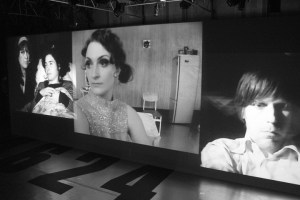
Gob Squad's Kitchen

Gob Squad’s Kitchen (You’ve Never Had It So Good) photo by David Baltzer

It was the first time The Public offered seats to Twitter users for the purpose of sharing thoughts about a play in 140 characters or less. The designated tweeters sat in the last three rows to minimize disturbing other audience members, and the theater gave us a number of rules to observe during the performance: No phone calls, dim your screens, no photographs (this was lifted moments before curtain, and several people did tweet pictures). There’s been loads of debate over the usefulness of tweet seats on blogs, news organizations and, of course, Twitter. I figured I’d share my experience of The Public’s Great Tweet Seat Experiment, and encourage theaters and theater goers to continue contemplating this divisive topic.

When I heard The Public was offering its first ever live tweeted play, I wanted to join in. After applying for a spot, the marketing staff chose me as one of 25 participants. One of my main interests, beyond seeing The Gob Squad for the first time, is my work in transmedia and interactive art. I was very curious to observe the reaction of the audience, the tweet seaters, and those following the #kitchenlive hashtag at home. There seem to be two camps in the live tweeting of theatre – the passive and the interactive.

One debate point that arises regarding live theater tweeting is over “passive tweeting.” Passive tweeting was what I experienced at Gob Squad’s performance. The tweet seaters essentially called a play-by-play of the play. Anyone following the hashtag read thoughts like:

shimmeringcell: This is hilare/nuts. Even the Public ushers are cracking up.

Or:

msteketee: Middle screen blonde actress has now donned the Edie Sedgwick striped shirt. Yes.

And criticisms such as:

nikkipatin: Just like Sontag last week, the technology utilized is far more interesting than the performance itself.

People live tweet concerts and television all the time. From concerts, tweeters share pictures and video of singers on stage and drunk friends acting asinine. The difference between a play and a concert is, typically, there’s no plot. With television, a wider, communal experience occurs; whereas, with a play only a few handfuls of tweeters share mainly with friends and colleagues. Does tweeting a play really make a difference, and if so, who cares?

For me, at least a few people cared. Responses varied. Some energized followers jumped in:

jennyg29: @PublicTheaterNY @jdcarter Digging the hell out of this #kitchenlive experiment. Hurray #Transmedia!

Fellow tweet seaters conversed with me:

adamjohnfrank: @jdcarter #kitchenlive yea, the plastic bag over the head is kind of freaking me out…

Audience members at the show who weren’t live tweeting joined in the feed after the fact:

AKwritenow: @jdcarter @PublicTheaterNY I was unPREPARED for how awesome #GobSquad #kitchenlive was.

The strongest interaction of the night came when I suggested it would be great if our tweets interacted with the show, a friendly debate (with a user following the #kitchenlive feed from home) over passive and interactive live tweeting ensued:

jdcarter: I wish #tweetseats tweets interacted with #kitchenliive and affected the performance. Or they responded. #interactive

jennyg29: Agreed. RT @jdcarter: I wish #tweetseats tweets interacted with #kitchenliive and affected the performance. Or they responded. #interactive

dloehr: @jdcarter There’s not much point otherwise. (Course, tweets from outside might have an effect, too.) #kitchenlive

jdcarter: @dloehr really? You think? It’s not like live tweeting any other event? Interaction is nice, but not necessary. #tweetseats #kitchenlive

dloehr: @jdcarter No, it’s not like other events. But I’m not a fan of passive live tweeting of theatre. #tweetseats #kitchenlive

Scamandalous: @dloehr @jdcarter Passive? As opposed to sitting in a theatre and NOT tweeting? That’s active?

dloehr: @Scamandalous @jdcarter Audience mood affects every performance. The only truly passive audience is deaf, blind & unconscious.

Scamandalous: @dloehr @jdcarter YOU were the one who used the term “passive,” not me.

dloehr: @Scamandalous @jdcarter Sorry. Sitting without tweeting has often been called passive out here on twitter.

Scamandalous: @dloehr @jdcarter I just don’t see how live-tweeting is less active. Maybe you don’t think you can engage in the work enough?

dloehr: @Scamandalous @jdcarter We can–and should–make art that can incorporate this & truly involve audiences beyond the level of chatter.

Scamandalous: @dloehr @jdcarter That is interesting to me. I did think it was a unique experience livetweeting and reading others’ tweets though.

dloehr: @Scamandalous @jdcarter Livetweeting the tv, you can pause, rewind, etc. Theatre can’t do that, unless the show’s designed to use tweeting.

I resigned myself there’s two kinds of live tweeting and each has its place. I’ve always been a proponent of criticizing plays for what they are and not what we wish them to be. Like the play itself, we should examine live theatre tweeting for what it is. If there are two ways to live tweet an event – one where tweeters report and one where they interact – let’s consider the advantages and disadvantages of each.

For me, as a theatre and transmedia artist, the most exciting artistic use of Twitter (or any social media for that matter) a production integrates tweets into the experience, either allowing the audience or user at home to interact with the show or characters/actors share personal updates integrated before, during or after the performance.

Some companies have integrated tweeting as part of the narrative. The Royal Shakespeare Company partnered with Muldark, a cross-platform production company. Together, they created Such Tweet Sorrow, a five week, improvised Twitter adaptation of Romeo and Juliet. Actors took roles of central characters in the tragedy, and they tweeted as the characters living in contemporary London. Also, Waterwell’s#9 explored “how we use technology and technology uses us,” according to their website. The company invited the audience to live tweet the show with the hashtag, #9. They LiveStreamed the play, and viewers at home engaged in the live tweeting experience. Waterwell pulled the hashtag stream and fed it real time onto video screens in the theatre, much like super titles, which has been suggested in this tweet seat debate. I participated through the LiveStream, and though it was fun to see my tweets pop up as some sort of “inner tweetologue” of the play, though they never fully interacted with the performance.

I asked The Public’s marketing director, Nella Vera, to share her thoughts on the Gob Squad tweet seat experiment. Ms. Vera said:

“I think many of our tweeters enjoyed being able to share their thoughts on what was happening on stage, but also found that it was a bit of a challenging task – keeping one eye on the stage and on your phone is not as easy as it seems!  Because it was a large group sitting together, many of them commented that they enjoyed being able to ‘talk’ with each other without disturbing the show and share impressions; this added to the communal feel of the event. They liked being able to see how others were reacting to the work and how it compared to their own thoughts.  In a way, it actually enhanced the very thing theater tries to do—bring people together to share ideas.  This is not something we would do on a regular basis but it is fun to consider if the work lends itself to such an environment.  (For example, our Joe’s Pub venue is already a tweet-friendly zone where fans of the musicians regularly take photos and videos of performances.)”

A way to view passive tweet seaters is to consider them press. This is the second production I attended this season (the first, Nightmare NYC) for which I was specifically invited to tweet the event. At Kitchen, a couple tweeters referenced this:

Shimmeringcell: Whoa, we have laminated press passes with our names on ‘em, drink tix, & swag!

Scamandalous: This makes me feel like real press! #kitchenlive, baby!

They felt like real press. Perhaps even a critic. The night I attended was, indeed, a press preview. I saw David Cote of Time Out New York dart out just after the curtain call. What if, in addition to his regular review, Mr. Cote sat in the back and live tweeted with the rest of us? Would there be an immediate box office jolt for the show if a critic’s tweet hailed a performance? Automatic dive if it panned? Over the past couple years, bloggers have gained credibility with producers as viable critics. Might tweeters be taking their rightful seats next to blog and mainstream critics? I’m not suggesting reviewers begin reviewing on microblogs, but if there’s a place for the long form bloggers, why not tweeters, too?  Obviously, there’s already been plenty of fire against tweeting about plays before they’re ready for prime time (Spiderman: Turn Off the Dark, anyone?), but what if the tweet seats landed on press previews? That certainly doesn’t preclude the average theatre attendee from sharing her/his thoughts after the show, but it might encourage microbloggers to attend a preview worth sharing.

Ms. Vera also offered some marketing statistics from the tweet seat night. “Although the intent behind the event was not purely a marketing one,” said Ms. Vera, “it is interesting to note that there were a total of 483 tweets generated, resulting in 270,359 impressions, reaching an audience of 32,700 followers.  That’s pretty amazing for 25 people!”

Indeed it is. 25 live tweeters reached 32,700 people. For theaters, it may not just be about creating artistic interaction. It may be about spreading the word. And for an experimental theatre show imported from England, I’m sure it can use all the word of mouth it can get.

photo by David Baltzer

For many reasons, Gob Squad’s Kitchen (You’ve Never Had It So Good) was the perfect play on which The Public to experiment with tweet seats. The Gob Squad is forward thinking, media focused, and experimental, and so is Twitter. One of the biggest concerns/complaints of tweet seats is potentially distracting other audience and performers. The troupe performs 98% of the play obscured by a giant video screen behind which live three simple sets: a bed, a stool, and, of course, a kitchen, which are all projected onto the screen thereby minimizing actor distraction. In fact, prior to performance, the actors invited the entire audience backstage to walk through the sets, and they were excited to greet the tweet seaters. The show proposes recreations of several Andy Warhol films made in the heyday of The Factory, and these vignettes offer a meta-theatrical-video-film experience you have to see to understand. According to The Gob Squad’s website, it is, “A quest for the original, the authentic, the here and now, the real me, the real you, the hidden depths beneath the shiny surfaces of modern life.”

Sound pretentious? I thought so. And one of my followers who kept up with the #kitchenlive hashtag said our tweets made it sound pretentious, too. I guess we didn’t do a great job of conveying the experience because it was downright fun, funny, thoughtful, self-referential, and one of the best uses of audience participation I’ve seen in a long time.

I think that’s why I was only slightly disappointed with this specific tweet seat experiment. I wanted to be up on stage with the other audience participants. I wanted to interact. But I was stuck in the back row, sharing my thoughts with people who didn’t have context of my experience. I wanted more. But that’s just me. Someone else had a completely different experience, and that’s how life works. Each of us has her/his own perspective, and in the end, we’re each trying to find the original, authentic, the here and now, the real me, the real you, the hidden depths beneath the shiny surfaces of modern life.

It was an experiment, and like all experiments, some succeed and some fail. This one felt pretty positive. There’s always room for improvement, and I look forward to the evolution of this social-theatrical happening called tweet seats.

As Ms. Vera shared, “Overall, I think a good time was had by all and we truly thank everyone who participated. We learned a lot and I’m sure we will be having internal discussions about this for quite a while.”

Thanks to all my fellow tweet seaters, and special thanks to Nella Vera and The Public Theater for the tickets and their bravery.

it’s so absurd

This morning, I woke up confused. And a little disappointed. It’s because of this.

I’m confused because it doesn’t seem Diane Snyder saw the same play I saw. Or, perhaps she was reviewing a play she wished she was seeing. Whatever the case, I’m troubled because I generally praise Time Out New York for reviewing a play for what it is, rather than what they wish it might be.

Specifically, Ms. Snyder wrote:

 “This wickedly twisted premise unfortunately strays far from the path of logic, putting shock ahead of sense.”

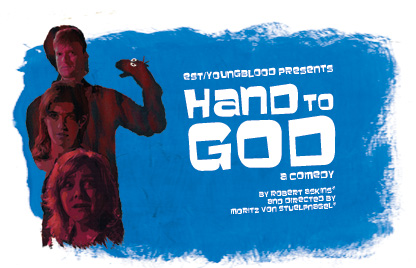
So many great plays have done this. Absurdist gems like Rhinoceros, Pterodactyls, Sister Mary Ignatius Explains It All For You, and The House of Blue Leaves  paved the way for the smart hilarity that is Hand to God.

But maybe, Ms. Snyder thought she was seeing a play by Greenberg or Simon.

I don’t know.

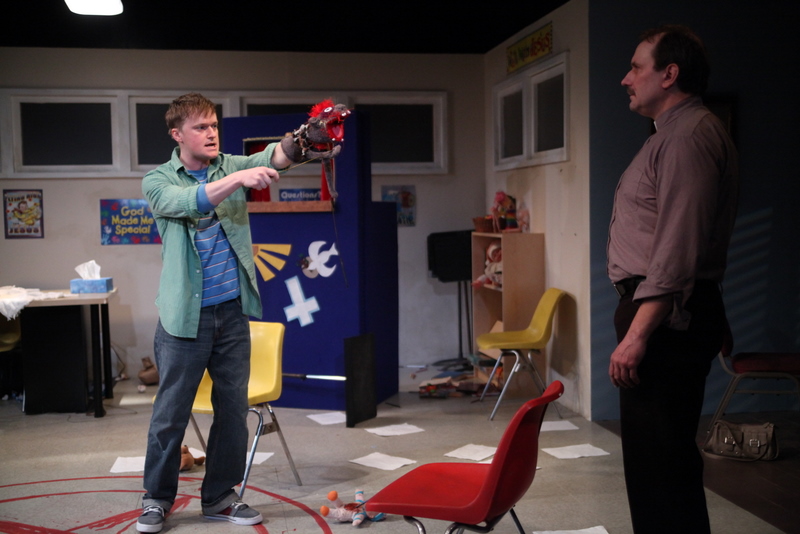
The problem is: no one reading the review in Time Out New York will know how sorely the review misrepresents Hand to God. Readers will think it is a traditional comedy about a teenage boy trying to get over his father’s death. Sure, this is the plot, but more importantly, it’s a brilliant, absurdist morality play revealing how people manifest mythology, like the devil and sin. Any time puppets appear on stage they are a metaphor for something larger. If Ms. Snyder focused on the play’s raucous metaphors rather than its literal storytelling, perhaps she would have seen what I saw.

Here’s my perspective:

Steve Boyer and Scott Sowers. Photo: Gerry Goodstein

Steven Boyer knocks it out of the park with a career making performance. His nuanced performances as both Jason, the teenage boy who recently lost his father, and Tyrone, a possibly devil-possessed puppet, should win awards and earn him work. It’s a tour de force in the truest sense of the phrase. Through him, the funniest fight with one’s own hand since Evil Dead and the hottest puppet sex since Avenue Q currently grace The Ensemble Studio Theatre‘s main stage. The best thing Ms. Snyder wrote was that his performance is “a big hallelujah.” Amen, to that.

Geneva Carr and Scott Sowers. Photo: Gerry Goodstein

Geneva Carr is magnificent and slightly frightening as Jason’s tortured, widowed mother, knowing she doesn’t need the consoling, security of a man her own age. She wants the release of a teenage boy’s cock. She wants to feel the pain. If ever someone literally took the advice of Peaches, it is this woman.

Pastor Greg, earnestly played by Scott Sowers, grounds the play. He is that audience member asking “WTF?!” We accept everything onstage because this guy doesn’t get it either. In the end, it’s his blind faith and moralizing that is the butt of the play’s joke.

Bobby Moreno was born to play the part of Timothy. He has one objective: to get laid. Sometimes, characters only exist to make us laugh, push the story forward and offer some of the best physical comedy you can find in the theatre. This is Timothy’s role, but Bobby brings pathos to this single minded boy. And he’s funny as hell.

Megan Hill embodies Hand to God‘s ingénue, Jessica, with awkwardness, sweetness and a simmering sexuality. She’s the smartest of the bunch and the voice of reason. She makes us understand love, connection and sincerity and isn’t found in a book or set of rules, dead fathers or socks shoved onto one’s hand. These joys are discovered in other living human beings willing to turn the rock over and see a beauty no one else understands.

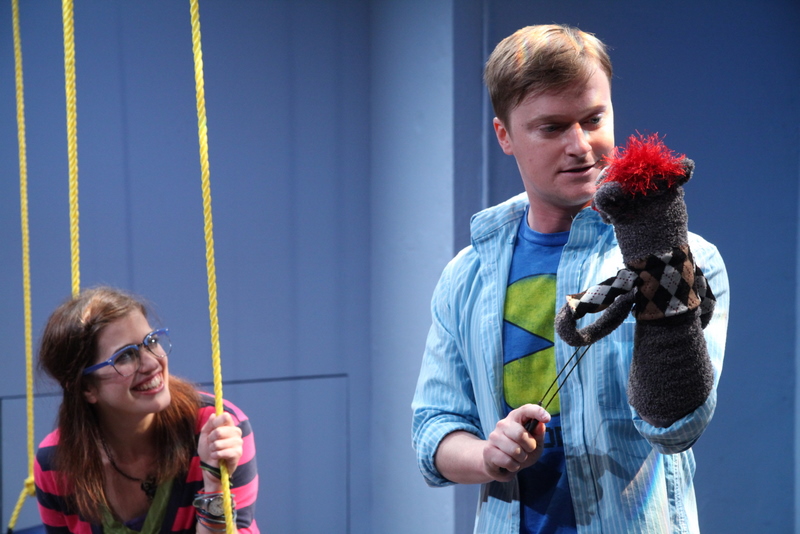
Megan Hill and Steve Boyer. Photo: Gerry Goodstein

Then, there’s Tyrone. Oh, Tyrone. Like so many ids who’ve come before him, Tyrone is the embodiment of young Jason’s desires. He’s everything Jason wishes he could be. Jason doesn’t want to admit it, and he doesn’t like it. But the venomous words Tyrone spits at other characters and the audience are deep truths. And, as we all know, the devil speaks the cold, hard truth. He has since the beginning. And he does again here in the form of the potty-mouthed Tyrone.

Orchestrated with deft precision by Moritz von Stuelpnagel, the hilarity of his mad-capped crew rarely lets up, but when it does, the simple offerings of human connection are never overly sentimentalized. Some of the best physical comedy this season is in this production, and Moritz deserves credit for bringing this brilliant play to life.

Like his predecessors before, Robert Askins’ wrote a new absurdist gem in Hand to God. He joins a young crop of smart and bizarre playwrights, like Leah Nanako Winkler and Josh Conkel, who create uniquely theatrical experiences bent on forcing us to examine our humanity and the silliness of it all. These voices must be encouraged and appraised for what they are, not what reviewers wish they were. They create outlandish scenarios that serve as metaphors for the overly sentimental, stuffed-up, class-driven realism passing for plays these days.

It isn’t experimental theatre. It isn’t kitchen sink. It is absurdity its best, and it’s a departure for The Ensemble Theatre. Artistic director William Carden should be praised for having the guts to produce it.

Okay. I’m done.

Please, don’t consider this a review. An open letter to Diane Snyder of Time Out New York? Maybe. An endorsement? Definitely.

In the end, I’m just a playwright, hoping to help another schmoe who’s in the same boat. Rob’s a brother in theatre, and he deserves for people to see his work for what it is.

Go see Hand to God before it closes on November 20th. It’s wicked good.

biggest obstacle portraying tech in theatre? people.

Recently, I was tagged in a comment thread on Facebook after American Theatre Magazine raised a question posed by one of its fans:

Which plays effectively incorporate contemporary communication technologies – interactions on Facebook, Twitter, Skype, online chat, texting, etc? How have they overcome some of the obvious challenges in portraying those types of communications?

Carleigh Welsh, Sponsorship Consultant for Performance Space 122 and Director of Marketing and Communications at The Levitt Pavilion for the Performing Arts, mentioned my play Feeder: A Love Story, which was super sweet. Our team worked hard to integrate prerecorded and live video feeds and create a fun and engaging online experience.

I’m happy to see this question asked, and I especially enjoyed the query’s frame, presuming there is theatre successfully incorporating these technologies. I eagerly read other responses in the comment thread since I include this in my work. I’m always on the hunt for theatre integrating tech well. A few suggestions were Carlos Murillo’s Dark Play or Stories for Boys, Real Girls Can’t Win by Merri Biechler, Tommy Smith’s Girlfriend, and even Patrick Marber’s Closer.

Then, a man wrote: The experience of using those technologies is innate anti-theatrical.*

A woman immediately responded to the comment: That is piffle.

The man’s retort?

People spend ALL DAY LONG looking at screens, why would we expose them to that when they pay money to come to a theater? I suppose if you wanted to talk about how boring these technologies make people that would make a great play.

One of the obvious challenges in portraying those types of communications is overcoming prejudices of theatre purists like this fellow. Theatre is a congregational experience that entertains with live performance supported by a vast array of tools. Technologies are tools just like puppets, costumes or sets. To fully expand creatively, we should use every tool in the box. Even Annie Dorsen’s Hello Hi There, which employs no actors whatever, is a theatrical exploration of these technologies. Is it a play? Not in the traditional sense, but it is theatre.

If “people spend ALL DAY LONG looking at screens,” why wouldn’t we portray that on stage? Are we supposed to pretend computers, mobile devices and video technology do not exist? They permeate every moment of our lives. To keep theatre isolated is limiting and dogmatic. A better question is, “How can one write a contemporary play and completely ignore technology?”

People debate: What is theatre? What is good theatre? What is the best kind of theatre?

Who cares?

Expressing opinions freely wherever one wishes is healthy. Open people might listen and learn. Closed-minded individuals will continue to write negative drivel on comment boards and Facebook walls. I create theatre that matters to me, and fortunately I’ve met others who create theatre to which I aesthetically and emotionally relate. There are markets for everything, and so it is with theatre. Whether it’s downtown experimental performance art, a well made play on Broadway or something in between, we’re all in this together. Why spent time debating theatrical purity when it’s subjective anyway? All that matters is whether the show moves and entertains the audience.

Transmedia storytelling is a big part of the work I do. Transmedia isn’t for everyone, nor should it be in every play because not every play calls for it. However, those who suggest tech tools have no place in theatre should go to Broadway and see a musical or two. Most implement some sort of “multi-media” and have for over 20 years. If people do not want to see technology on stage, those plays certainly exist. If you value that aesthetic, support it and let tech advancements continue evolving theatre elsewhere.

As part of their 50th anniversary, Theatre Communications Group created a blog series called the “What If…” Project, asking what if we imagined the theatre field of the next 50 years, and began making visible progress today? TCG kindly invited me to respond to the question, What if Theatre Embraced Transmedia? Funnily, there are still people out there who can’t even face the question “What if theatre embraced multi-media?” If we are to make progress, we must accept both.

Opposing the integration of communication technologies in theatre is artistically irresponsible. As long as we keep embracing technology in our daily lives, it should continue on manifesting onstage. Art reflects life, and life includes technology.

*All grammatical errors belong to the poster.

___

If you’re interested in hearing me speak more in depth about these topics, I’m presenting on Tuesday, April 26, 2011 at the Transmedia New York City Meetup. I’ll share details on the creation of my play Feeder: A Love Story, and discuss examples of theatre taking up technology in this new and exciting fashion. There are still slots available. It’s free, and you can SIGN UP HERE.