gettin’ busy

The past week’s been a bit of a blur and completely fantastic.

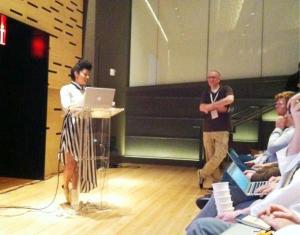
Me, preparing for our project presentation at last week’s StoryCode hackathon. Yes, I ate all those pizzas behind me. (Big up to Amanda Lin Costa’s article on PBS’s Mediashift where the shot is featured.)

When I greet my friends and ask how it’s going, I often get the answer, “Busy.” Typically, they follow the response with a heavy sigh or a diatribe about the pressure they’re under at work. I’m conscious of giving this canned response to people when I’m asked the same question. If I do feel the need to tell people how busy I am (I live in New York – like I’m ever not busy?), I try to let people know it’s a “good busy.”

Last I wrote here, I was gearing up for the first ever transmedia StoryCode Hack: Beta offered by StoryCode, a new not-for-profit supporting transmedia/cross-platform projects. For the past couple years the group has been just that: a Meet Up group that gave speakers a forum at which to share case studies of successful projects. When Aina Abiodun and Mike Knowlton incorporated, they fashioned this mission:

StoryCode is a non-profit community hub for independent immersive and cross-platform storytellers; supporting, incubating and showcasing projects created by them.

Aina Abiodun and Mike Knowlton introducing the StoryHack presentations.

Their action shift was the incubation directive. Transmedia Meet Up groups the globe over offer panel discussions and speakers showcasing projects, but StoryCode kicked it up a notch. They’re in the business of cross-platform story formation. StoryCode realized creators are tired of talking and want to get their hands dirty, fail and learn from those failures.

I’m not going to go into the details of the Story Hack here. My super awesome US Maple hackathon teammates, Randy Astle and Carrie Cutforth-Young give great analyses here, here, here, here and here.

The hack home stretch before presentations.

What I want to acknowledge is the community created. Real community can’t sustain unless its members feel fed, and this past weekend, 27 storytellers, developers, game designers, filmmakers, and theater-makers devoured the challenge, nourished themselves, and grew into a team of transmedia creators.

It was the most fulfilling artistic experience I’ve had this year.

On top of all this, last week I announced my new project, NY_Hearts: LES, which is part of the Game Play Festival at The Brick Theater. StoryCode provided the platform for me to share this exciting project and ask for immediate essentials I need. I sought an associate producer, a geo-tagged location based storytelling platform, and small business partners in the Lower East Side. With this assistance, I’ve fulfilled several of these needs. You can read more about one of the new developments on the NY_Hearts blog.

It’s challenging to make new work, and thanks to StoryCode and The Brick Theater, I’ve been busy. Very good busy. And I hope to continue being good busy for the next several months.

team u.s. maple – storycode hack: beta

FROM VAPORS…STORYCODE EMERGEDImage
For a little over a year, I’ve been entrenched in the transmedia world, and part of that immersion (pardon the pun) includes StoryCode, a not-for-profit that grew out of the Transmedia NYC Meet Up.

StoryCode is blowing up. Between its new residency at Lincoln Center Film Society, partnerships with Kill Screen Magazine, becoming a legit company, and the creation of new programs like StoryCode Immersions — monthly small group “deep dive” sessions into focused topics like tech, fundraising and entrepreneurship — StoryCode supports the transmedia community like no other organization in NYC. In addition to offering case studies and environments from which creators may learn, StoryCode fosters environments in which creators can, well…create.

RELEASE THE HACKATHON
Image
Like so many companies, StoryCode is implementing the hackathon structure to create new work and bond its members. Like the 24-Hour Plays (or the 47:59 Play Festival for which I wrote a few years back), this experience plans to fast forward the story creation process. Over 24 hours, teams of four work to develop a brand spanking new transmedia project pitted against other teams. Storytellers, producers, video artists, and programmers converge to birth and present projects in hopes that judges proclaim their team winner of the first ever StoryCode Hack.

I’m super psyched to meet all my team members tomorrow at orientation and head into next weekend’s hackathon with fire and fury. The competition is fierce. Friends will become enemies. Platforms will be compromised. And one team will reign victorious

Check out our cheeky team description below, and follow Team U.S. Maple on Twitter or Facebook for more on this madness as it develops.

OFFICIAL (UNOFFICIAL) U.S. MAPLE PRESS BLURBImageHow do four strangers, who have never licked each others’ faces, unite to create an epic transmedia spectacle that unfolds on three platforms in only 24 hours??? Armed with only two Panasonics DVX-100s, A CASE OF RED BULL and a DREAM, TEAM U.S. MAPLE will document their entire experience where they collide together to accomplish the seemingly impossible (but not quite impossible and therefore definitely attainable ONLY due to this motley crew’s MAD SKILLZ) for Storycode’s Hackathon’s TRANSMEDIA CHALLENGE. Follow us on Facebook and Twitter as we update LIVE from inception to conception AND BEYOND.

FOUR STRANGERS!!!! THREE PLATFORMS!!! TWO PANASONIC DVX100a’s!! ONE EPIC TRANSMEDIA STORY EXPERIENCE LIKE NO OTHER! = TEAM U.S. MAPLE smacking down at Storycode’s Hackathon. ROOT for them ONLINE (throughout the week on FACEBOOK & TWITTER) and IN PERSON at the Lincoln Center April 28 & 29th.

To learn more about the challenge the team faces visit hack.storycode.org

ze frank returns

Ze never actually went anywhere. He was doing things. Important things. Life things.

At the end of February, I discovered Ze Frank was bringing back his show, The Show. He created it back in 2006, and it was awesome. My girlfriend at the time, who later became my wife, and I shared these videos back and forth when we were courting. They were special to us. They were special to a lot of people. We bonded. We learned. We played. We grew.

To bring back The Show, Ze ran a Kickstarter campaign, but unlike other Kickstarter campaigns, Ze’s only lasted 11 days as opposed to the typical 45. Just to make a point, his goal was $50,000 in 11 days. He made it. In fact, he almost tripled it. In 11 days, Ze Frank raised $146,752. I am proud to be one of the 3900 sponsors of Ze’s new show, A Show.

How much money he raised isn’t really the point, but if you’re interested in knowing more about the details of this stupendous feat, Ze wrote a really detailed post mortem recapping the fundraiser here.

The point is, Ze posted a “preview” of A Show online this past Monday.

Yesterday, the first episode of A Show launched.

Thanks, Ze, for doing what you do. I’m excited, and many others are, too. Can’t wait to find out what hijinks you have in store.

As for me, I have to start writing down my dreams…

the truth of the matter

“The ethical value of one’s actions depends on their anticipated and predictable consequences.”
– Noam Chomsky

“Truth is the most valuable thing we have, so I try to conserve it.”
– Mark Twain

“The Truth is more important than the facts.”
– Frank Lloyd Wright

I’m going to say it. There’s a bloody carcass in the middle of the room, and everybody’s pouncing on it. Mike Daisey said and did some things. Things – from his world view – that didn’t jive with much of the rest of the world’s view. Journalists and theater practitioners alike have weighed in. I’m weighing in again, hopefully for the last time.

Let’s try to forgive.

I know. Too soon. Some will forgive. Some won’t. But what if we did?

There’s a line. Everyone has it. I have it. You have it. It’s that line you won’t cross. We assess how much collateral damage one is willing to leave behind after one crosses “that line.” For some, they’d do anything for fame, power, or money. They’d do anything to get ahead. Kill. Maim. Torture children. And I’m just talking about FoxConn. Others will go to war to change the world. Our own nation does it time and time again.

But we collectively accept those lies. Those ‘truths.’ We allow politicians to tell us one thing one day, and another the next. We watch television and call it reality. We accept cock-and-bull from pundits and players looking to get paid for stirring up the pot. And Mike Daisey stirred it up.

Let Mike do what Mike does, I say. The karma he’s created is strong. He knows this indiscretion will follow him, so let Mike wrestle with his own conscience. We need to focus on how we can be diligent and smarter theater artists and administrators. This event can strengthen our industry, if we learn from it. If we take our eye off the ball because we’re nitpicking at each other over the way one man portrayed “The Theatre” in the mass media, we’ve got deeper problems than I thought. We must continue endeavoring to change the world for the better with our work.

This is the purpose of The Agony and Ecstasy of Steve Jobs: To change the world. Its message deserves to continue. The working conditions at FoxConn are much bigger than Mike, his few fabrications, or the theater arts. Many artists are preparing presentations of Mike’s downloadable monologue. When these performances occur, I hope they are presented in context. By providing context, the truth of the story lives on, preserving the facts, while informing the audience of the monologue’s mendacity. It’s how Mike must contextualize the story now, and this framework imbues it with integrity.

As theater practitioners, we want the world to notice us. We want so badly to carve out a niche for ourselves because the slices are so small. There isn’t enough for all of us to eat, so when one of our own falls, we leap on the carcass in front of us. But what does it say about us when we cannibalize our own? Certainly, this is a great opportunity to reflect and discuss ethical and litigious issues, but shredding Mike Daisey does little more than throw fuel on an already raging fire. Let’s quench the flames and choose to rebuild.

We’ll be stronger for it. And that’s the truth.

______

If you are in the New York City or Washington D.C. areas, there are two panels this week and next about these topics. Every crisis is an opportunity. Let’s use it to learn and grow.

Truth in Theater: A Conversation (NYC)
The Public Theater

Thursday, March 22 at 8pm
Seating is free but limited; for tickets, call the Public at 212-967-7555.
(This is not a Public production)
Convened by TONY theater critic Adam Feldman, the panel will discuss questions of veracity, ethics and artistic license in nonfiction-based theater. Participants include writer-director Steven Cosson (This Beautiful City), playwright-performers Jessica Blank (The Exonerated) and Taylor Mac (The Young Ladies of…), and critic-reporters Peter Marks (Washington Post) and Jason Zinoman (The New York Times).

Discussion at Woolly Mammoth Theater (Washington, D.C.)
Tuesday, March 27, at 7pm
Reservations are encouraged; for tickets, call Woolly Mammoth Theater at 202-393-3939
(This is sponsored by Woolly Mammoth)
A free and open discussion to the public. It will be hosted by Howard Shalwitz, Woolly Mammoth Artistic Director, and Jeffrey Herrmann, Managing Director. They aim to engage with the audience about this subject.

the transmedia and transgressions of mike daisey

Everyone’s always asking the question about Alternate Reality Games:

“Do you let your audience know it isn’t real?”

Alternate Reality Games or ARGs are common lingo amongst any of you transmedia folk who read this; however, to most of my theater colleagues and the general public, ARGs are something new. ARGs are interactive stories using real world scenarios with other media platforms to deliver a story that may be altered by participants’ ideas or actions. Often, in the beginning of an ARG, one cannot tell what part of the game is real and what isn’t.

Mike Daisey Photograph: Kevin Berne

Mike Daisey’s The Agony and Ecstasy of Steve Jobs has been a news sensation sensation since last year. It brought attention to the poor working conditions for Chinese laborers in FoxConn factories that make most of Apple’s devices. Yesterday, the story surged again. This time, the news was about Mike, himself. In an episode titled “Retraction,” Mike admitted to “This American Life” host Ira Glass certain portions of his monologue are fiction. Now, the issue of truth – not only in journalism but also in theater – is being called into question.

The monologue – whether by design or accident – became transmedia with Mike’s appearances on multiple television shows, news programs, and his blog. Mike also did something he had never done before: He wrote down his script. Famous for only performing with an outline, Mike transcribed the monologue and made it available for download so anyone in the world may perform the text royalty free. This act for a playwright is rare. It’s benevolent, and it helped spread the story.

Mike spurred countless to act. But as puppet master, the beast got to big for him to wrangle. I’m not suggesting Mike started out with a plan to fool the world, but once people became mobilized, everything changed. Sometimes, people tell the stories they want to be true because it will change reality.

Going to the theater, whether for a live performance or film, we suspend our disbelief. We do this with books, games, and even campfire stories. We know there’s not really a boogieman coming to slash us in our tent in the night, but we still might lose sleep as our imaginations run wild. Even with true stories, we all know there’s a little embellishment tossed in for flavor.

When I saw The Agony and Ecstasy of Steve Jobs, I never thought it was 100% true. I’ve worked with too many playwrights and solo performers to know personal stories are massaged, characters combined, and scenes interwoven to manipulate an audience’s emotions. I assumed Cathy, Mike’s translator who appears as a main character in the monologue, must be a composite of several translators Mike employed as he traveled China.

Still, I was converted. I became an evangelist for the cause. I did exactly what Mike wanted me to do. I posted Mike’s final plea to the audience on my blog. I emailed Apple CEO Tim Cook. I allowed the meme Mike dropped into my brain to grow into a belief and change me. That’s what good theater should do. It changes people.

But now, all the world’s truly a stage. Pundits and reporters are merely players spouting half-truths to advance causes. That’s what Mike did. He discovered a way to spill the story out from the theater and into the mainstream media to activate real change.

However, during the initial fact-checking of Mike’s monologue for “This American Life,” Mike continued the ruse, which was his horrible misstep. People are happy to be entertained by fiction. They’ll even be inspired by fiction to change the world, as I was. They just want to know whether they should suspend their disbelief or not. Mike didn’t offer that option.

In 2011, I saw another solo show based on a true story. When John Leguizamo’s Ghetto Klown played on Broadway, John included an author’s note in the Playbill about the authenticity of his stories:

“While based on truth, events within the play have been re-created for clarity. Some moments in the piece fall out of their original timeline to create a more streamlined narrative. One or two characters are an amalgam, but all are portrayed true to my remembrance of them. I had to change some names at the behest of my lawyer for litigious reason. Though all the dialogue is essentially true, it has been distilled and concentrated. I’m not a good liar, so it’s not dramaturgy, only lack of artifice.

I wish to transport you into my world as I saw it – rootless and undocumented. It’s my endless quest to examine my life, to create a history and legacy where there wasn’t one. I try not to judge those chemical and electric moments that have forged me as a storyteller as good or bad, but as stepping stones toward self-expression and self-fulfillment. I always felt that the more times I told my tale to as many people as I could find, I could exorcise the pain from my soul. I also felt that the admission of my culpability immediately absolves me of responsibility for the consequences. Being self-aware means one is not lying. And no one outside of politics likes a liar. Doing a live autobiography before one is dead is maybe an act of self-destruction and maybe an act of shedding an old skin. It’s an act of self-hate and self-adulation. It’s many contradictory elements combined to create an illusion of normalcy, which hopefully allows you to come with me on this journey toward a victory over those forces we don’t understand, called life.”

Mike has a two-line disclaimer in the Playbill for The Agony and Ecstasy of Steve Jobs in all caps:

THIS IS A WORK OF NONFICTION.
SOME NAMES AND IDENTITIES HAVE BEEN CHANGED TO PROTECT THE SOURCES.

Changing names to protect the innocent is not the same as fabricating meetings with fictional FoxConn workers poisoned by the chemical n-hexane, used for cleaning iPhones. The difference between the two disclaimers is the lens through which the audience absorbs the stories.

One positive takeaway is the “Retraction” episode of “This American Life” is a solid hour of radio journalism. These days, when everyone is device driven and obsessed with retinal resolution, one of the earliest forms of media offered a riveting, revealing exposé. They shined a light on Mike Daisey’s betrayal of Ira Glass’ trust.

Ira even says to Mike: “I vouched for you.”

That means something. Especially to a journalist.

Context matters. Fictional stories can spread anywhere now and, too often, news organizations fail to vet them. One must be careful not to discredit one’s own cause. Even if Mike Daisey’s sprawling narrative wasn’t intentionally an ARG, there are many now who feel played. He stirred up the media, FoxConn, and the mighty giant, Apple. “This American Life” even continues to acknowledge this issue of poor working conditions in Chinese factories is not going away.

At the end of “Retraction,” New York Times reporter Charles Duhigg offered many facts about the working conditions. Then, Duhigg shifted to an editorial tone, impressing on Ira Glass:

“You are actually one of the reasons why it [the poor working conditions] exists.  If you made different choices, if you demanded different conditions, if you demanded that other people enjoy the same work protections that you yourself enjoy, then, then those conditions would be different overseas.”

Sounds like Mike’s Agony Ecstasy meme survives, which is really the objective of his monologue. It’s also clear when telling stories based on truth, context matters. Whether it’s a stage play, film or ARG, letting the audience know a story isn’t 100% factual protects artists from a world of scrutiny and offers the audience an opportunity to go along for the ride with abandon.

No doubt, Mike will rise up to tell a new tale. He’s a storyteller. It’s what he does. I’m sure he’ll come up with a hum dinger.

::

To download the transcript of The Agony and Ecstasy of Steve Jobs GO HERE

To listen to “Retraction” on “This American Life” with Ira Glass GO HERE